

by Lee Gettess
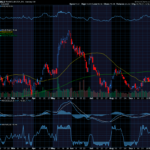
What we want to see is how the market is forming on intraday charts as they approach a system entry. These patterns have been discussed at great length. Much has been written about 1-2-3 or A-B-C patterns, and they are a good place to start. For those of you who are unfamiliar, let’s discuss a potential buy signal. A 1-2-3 and A-B-C (I will use these two terms interchangeably) is formed when the market has made a low of some degree, swung up in the next few bars to make a high, then fallen back down to a low that is higher than the previous low. These points (low-high-low) can be labeled as 1, 2 and 3 respectively. Once the market takes out the 2 point, a buy signal is indicated.
Some people only consider a 1-2-3 pattern to be in effect when the 1 point is the lowest low on the chart. For our purposes, we will consider any combination of swings that form in the 1-2-3 pattern to be potential signals. It is even possible for the 3 point of a 1-2-3 to become the new 1 point in a higher 1-2-3. In a strongly trending market, there can be numerous 1-2-3’s climbing up right on top of each other.
There are certainly some people who base their entire trading off of nothing other than these 1-2-3 patterns. Because of the basic nature of market behavior, it is virtually impossible for a market to go up very far without creating some type of 1-2-3 pattern. Most down moves are also initiated with a 1-2-3, and often contain several 1-2-3 sells within the down move. In short, it is a basic indication of how markets move. If a market is making higher swing highs and higher swing lows, it is going up. All of the linear regressions, least slope oscillators, neural networks with fuzzy logic, and astrological information can’t give you any more useful knowledge than that! This trading stuff doesn’t have to be that complicated!

It is usually much easier to view and understand these patterns after the fact. Now, Congress may be able to tax us retroactively, but they won’t allow us to trade retroactively, so we have to learn to anticipate.
As the market makes a low, then swings up to make a high, then swings back down, we are monitoring the whole process. At this point, provided this current swing down has not taken out the previous low, you have a POTENTIAL 1-2-3 to the upside forming. When will you know for sure? When the market trades higher than the “2” point. That will confirm the 1-2-3. You must always be recognizing whether the swings are moving higher or lower and what potential 1-2-3’s are forming.
Ideally, we would like to see one of these 1-2-3 patterns set up just below our system buy signal, or just above the system sell. If we can put our order at the breakout of the 1-2-3, and that is before the actual system entry point, the vast majority of the time that market will continue on so that the system will be entered.
By using the 1-2-3 for our entry, we have “beaten” the system by a few ticks. More importantly, we can place our stop just beyond the “1” point, which will drastically lower the risk on most trades. In fact, for those of you who are extremely risk averse, you can even place your stop just beyond the “3” point. This stop will get hit slightly more often, but it does cut your risk per trade even further. Remember, we are trading a system which uses daily data to identify where your risk is in a given trade. By going down to an intraday time frame, we are still looking for the profit potential on the daily but are cutting the risk down to the 15-30 minute level.
These set ups are great when we get a 1-2-3 in front of a system signal. However, the markets are not always so cooperative. In fact, markets are downright perverse most of the time. So, what do we do if there is no 1-2-3 in front of our signal point?
We start counting. Count the number of intraday bars that have made higher highs if we are approaching a buy, or lower lows if we are coming to a sell point. If the current bar is the third successive higher high, we will delay the buy. Conversely, if we are making the third lower low we will hold off on the sell. More directly stated, if we have less than two higher highs or lower lows as we approach the system entry, go ahead and enter the order. We may be able to limit the risk with intraday patterns once the trade is underway, but there probably isn’t much we can do to improve the entry.
If we are making at least the third higher high or lower low, we will not enter the order, but simply wait. Wait for what you ask? Wait for the market to continue through our entry point, then do some kind of retracement. The reason for this is that markets tend to move in “threes”. Regardless of time frame, you see many occurrences of 3-4 bars up, 3-4 bars down, even when the market is not trending. In fact, even when it is, it often goes up 3, down 2, up 4, down 1, etc. The probability of buying a market after 3 bars up and having it continue are not very good. The greatest probability is that it is do for a retracement. How large a retracement should occur is anybody’s guess, but we will be able to monitor it.
We need some objective method of entering the market when the system has signaled a trade, but we are still on the sidelines. In all but the most outrageously strong trends, the market will at some point make an insolated high or low after a system signal has been hit. An isolated high is simply a bar that has lower or equal highs on either side of it. For our purposes we will accept equal, but we would prefer the high after an isolated high to be at least one tick lower. The isolated low merely means that bars on either side of it have equal or higher lows. We prefer the bar after it to be at least one tick higher.
In the case of a buy signal, after the isolated high is formed, we begin placing our buy stops one tick over the highs of the bars as they descend. That is, we place our buy stop one tick over the high of the bar after the isolated high. Then, if the next bar has a lower high, we lower our buy stop to one tick over that bar’s high. We continue this process until we are entered, or until our Buy Filter tells us not to buy.









Recent Comments