
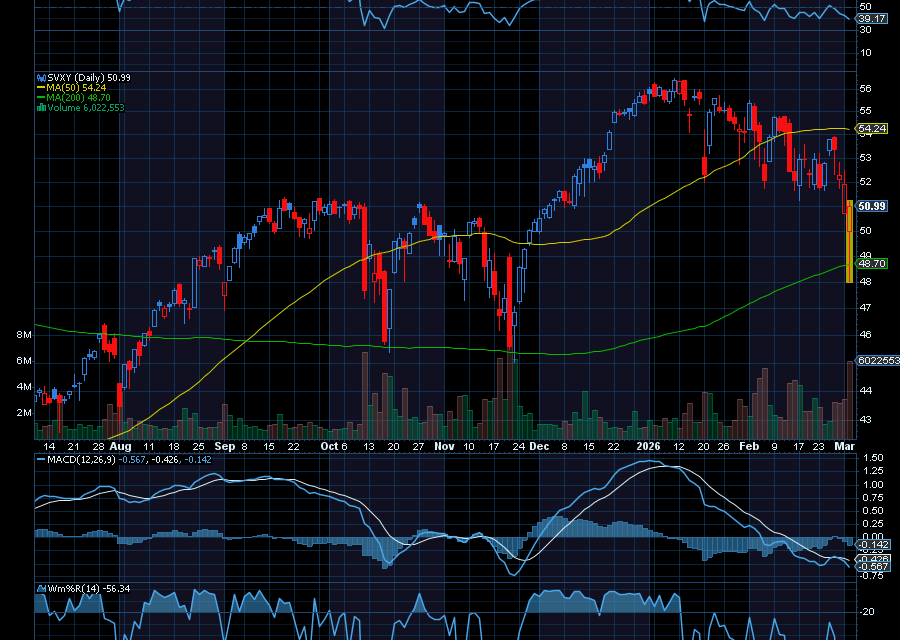
Keep an eye on the stretched Volatility Index ($VIX).
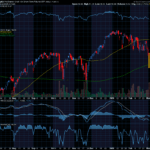
Now at 26.33, the $VIX is now challenging October 2025 trade war highs.
Nowadays, its Iran uncertainty driving volatility higher.
For one, the war appears to be widening. The U.S. embassy in Riyadh was hit by drones. The State Department ordered evacuations at facilities in Bahrain, Iraq, and Jordan. Hezbollah attacked Tel Aviv. And there are concerns about how long Gulf states can keep themselves safe from Iranian attacks. Plus, President Trump just said the conflict could continue for another four weeks, which raises uncertainty, which markets hate.
In addition, “Market anxiety ratcheted higher overnight amid concerns that a decapitated and leader-less Iranian government and military will execute a prolonged retaliatory response aimed at sowing chaos throughout the region by targeting key economic and energy infrastructure for weeks to come,” said Adam Crisafulli of Vital Knowledge, as quoted by CNBC.
Until there’s clarity, markets could slip even more. Oil could gush higher.
Eventually, the situation will cool off.
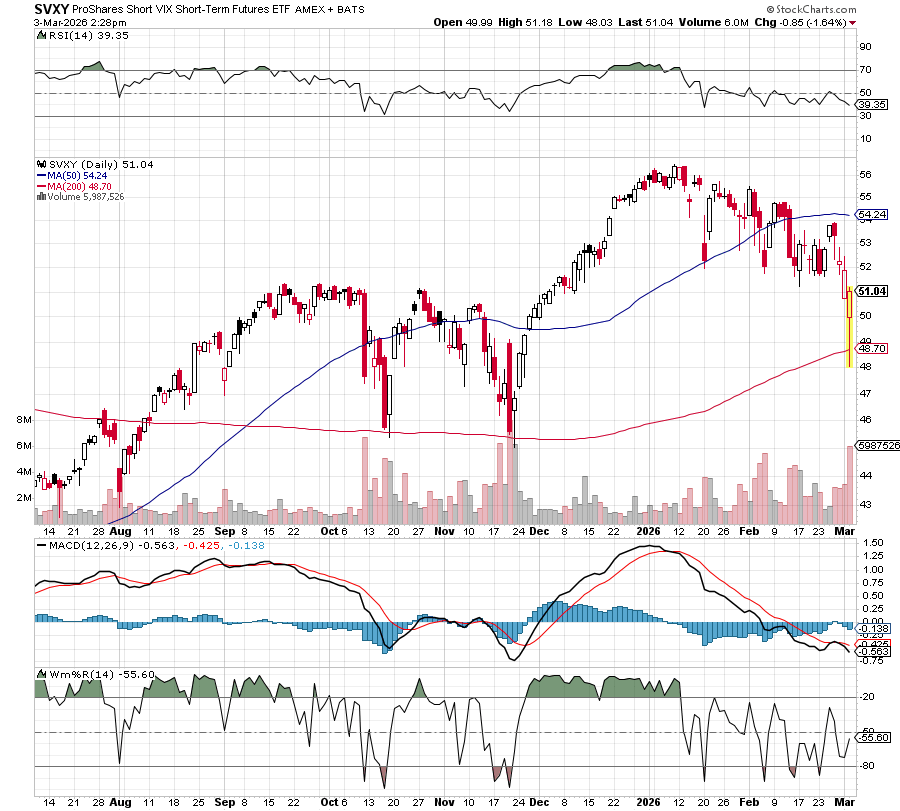

And when it does we’ll be offered an interesting opportunity on the short side of volatility.
Right now, even though tensions are sky-high, the $VIX is telling us that fear is too hot.
In fact, if you look at the $VIX dating back to early 2022, you can see that with every spike, RSI, MACD and Williams’ %R tell us when the $VIX is likely to pivot lower. We saw that happen in April 2025, December 2024, August 2024, April 2024, October 2023, March 2023, October 2022, September 2022, and also in May 2022. Each time the $VIX peaked with those three indicators, buying calls on the DIAs, QQQs and the SPY typically paid off well.
One of the best ways to trade an overheated fear gauge is by jumping into inverse $VIX ETFs, which move higher when the $VIX moves lower.
Some of the top ETFs to consider when that happens include:
ProShares Short $VIX Short-Term Futures ETF (SVXY), which seeks daily investment results, before fees and expenses, that correspond to one-half the inverse (-0.5x) of the daily performance of the S&P 500 $VIX Short-Term Futures Index, as noted by ProShares.com. It also has an expense ratio of 0.95%.
-1x Short $VIX Futures ETF (SVIX), is an inverse $VIX-linked ETF that seeks to provide daily investment results, before fees and expenses, that correspond generally to the Short $VIX Futures Index, as noted by VolatilityShares.com. As the $VIX drops, the SVIX ETF rises.
Sincerely,
Ian Cooper








Recent Comments