

by Duane Davis
We are going to talk about how the S&P 500 Index has performed during a 15-year period on each of the days of the week. During the bull market, the S&P 500 made most of its gains on Mondays. Then, during 2001 and 2002, Monday became one of the weakest days of the week.
Is a Very Weak Close a Warning Sign for Tomorrow?
Let’s take a look at the effect, if any, that Friday’s performance might have had on Monday’s trading. For example, when Friday is an extremely weak day, has that weakness had a tendency to carry over into Monday? As a trader, is an extremely weak Friday a warning that the S&P is headed lower on Monday? Let’s take a look at what an extremely weak Friday might look like the following.
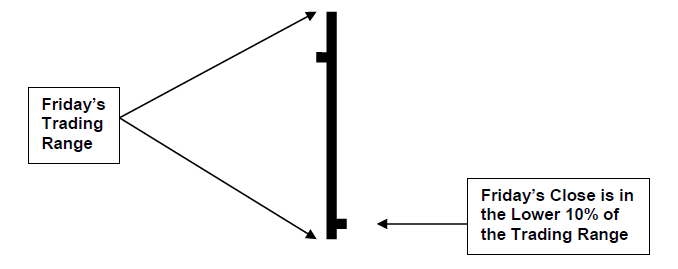
After a ‘terrible’ Friday, is Monday likely to trade higher or trade lower?
As it turns out, as bad it might look on Friday, Mondays actually have a tendency to trade higher. When Friday closes in the lower 10% of its range and is extremely weak, Mondays trade higher more than 70% of the time. For a day trader, the lesson to be learned here is that when the market is somewhat oversold; don’t be surprised to see it bounce back the following day.

But what about Tuesdays? How do Tuesdays perform under these same conditions? What we have found is that Tuesdays are not particularly exciting. This is an example of what we believe:
The day of the week is one of the most important ingredients to successful day trading
Is there a ‘common sense’ explanation for this difference? Perhaps there is. Here’s an example of one possibility. We looked at a chart of the S&P 500 Index from December 31st 1987 through December 31st 2002. In that chart, the S&P gained a total of 632.74 points. In looking at charts of the individual days of the week, we discovered: “nearly half of those gains have came on Mondays. We believe that most investors (including the professionals), study and make their investment decisions over the weekend. Because of this, Mondays have a tendency to trade higher during ‘bull market’ periods and lower during ‘bear market’ period.”
Now, let’s talk about at Wednesdays. When Tuesday closes in the lower 10% of its range, the net result of Wednesdays have been practically zero. The S&P has a tendency to decline around 12% of the 5-day average range before rallying into the close to finish at around the same price as where it began the day.
It’s interesting that Wednesdays have a tendency to trade somewhat similar to Tuesdays; the S&P typically declines early in the day and then rallies in the afternoon. Under the same conditions, Thursdays also have a tendency to decline early in the day followed by a rally into the close.
This is not the case, however, when these conditions occur for Fridays. When Thursdays close in the lower 10% of the range, Fridays have a tendency to trade lower all day. A weak Thursday often leads to a weak Friday. As day traders, we should always try to be aware of how the market closed the prior to our day trade.
If today happens to be a Monday (or a Tuesday if Monday is a holiday), and the close on Friday was very weak, in the lower 10% of Friday’s range, we should expect the market to trade higher. If today happens to be Tuesday, Wednesday, or Thursday and the close the day before was very weak, we should expect the weakness to continue until around mid-day, after which a rally should take the market higher into the close. On Fridays, be careful because a weak close on Thursday is likely to lead to a very weak Friday.
Is there a ‘common sense’ rule that might explain why the market has a tendency to respond the way it does under these conditions for each day of the week? We think so!
In our opinion, when the market finishes very weak and closes in the lower 10% of the previous day’s range a bounce back on Monday, Tuesday, Wednesday and Thursday is quite normal. This is not the case, however, on Friday. The short-term traders are often ‘long’ the market and they have a tendency to close out their positions going into the weekend. This added selling puts pressure on prices which is lacking on the other days of the week. Therefore, the combination of a very weak Thursday with additional selling prior to the weekend can make for a very weak Friday.








Recent Comments