
The small-cap weakness may be setting up an opportunity on the downside.
The Federal Reserve raised its benchmark interest rate by 25 basis points last week to a range of 3.75%–4.00% and signaled that additional tightening may be ahead as policymakers continue to battle persistent inflation. Higher borrowing costs can be particularly challenging for smaller companies, which tend to have less access to inexpensive financing than their large-cap counterparts. That concern remains in focus today, with St. Louis Fed President Alberto Musalem saying additional rate increases will likely be needed. Small caps have also shown notable relative weakness even as the broader market rebounds, reinforcing concerns that tighter financial conditions could continue weighing on the Russell 2000.
Here’s what the chart is telling us about the potential move ahead.
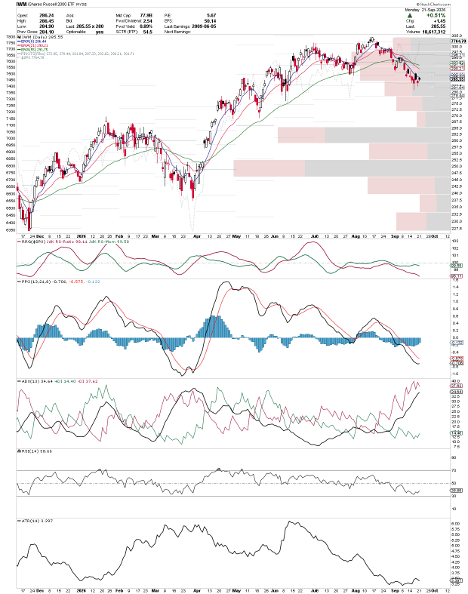
The IWM chart supports a bearish outlook, with price trading below its 8-, 21- and 55-day exponential moving averages. ADX has climbed to 34.64, indicating a strengthening trend, while −DI at 37.62 is substantially above +DI at 14.40, showing sellers remain firmly in control. PPO remains below zero with negative momentum, and RSI at 38.66 reflects weakness without yet reaching oversold territory. IWM’s relative-strength line versus the S&P 500 is also trending lower, showing small caps continuing to underperform the broader market. Together, the strengthening bearish trend and relative weakness support a put bias, particularly if IWM fails to regain its short-term moving averages or breaks below recent support.
Wishing you the very best,
Wendy







Recent Comments